Did this 255-carat crimson stone really belong to Cleopatra?
nicole gluckmanIn 1703, Dutch merchants trading out of Ceylon (the former colonial name for Sri Lanka) returned home with a curious pink stone with even more curious properties. When placed near a warm pipe, the stone appeared to come alive, attracting ash and cinders like a tiny magnet, only to push them away moments later. They had no word for what they were seeing, so they made one up: aschentrekker, aka ash-puller.

What those traders had accidentally discovered was pyroelectricity—the ability of certain crystals to generate an electric charge simply by changing temperature. It would be another few decades before the naturalist Carolus Linnaeus would give this same stone a more scientific-sounding name: lapis electricus, ‘the electric stone.’ And it would be nearly two centuries after that, in 1880, before the brothers Pierre and Jacques Curie used tourmaline—alongside quartz and topaz—in their experiments that would eventually lead to the discovery of piezoelectricity: the generation of electric charge in response to applied mechanical stress (like compression or vibration)—the phenomenon now humming quietly inside every quartz watch and ultrasound machine on earth.

Tourmaline, in other words, was as interesting as it was beautiful. And, as it turns out, it was also very, very good at fooling people.
In 1777, when King Gustav III of Sweden presented Russian Empress Catherine the Great with a 255.6-carat crimson stone, the Russian court was delighted. Rumored to have been gifted to Julius Caesar from Cleopatra, ‘Caesar’s Ruby’ took its place among the crown jewels, prized for over a century as one of the largest rubies in Europe.

Empress Catherine the Great & Sketch of Caesar’s Ruby
It wasn't until 1922 that the mineralogist Alexander Fersman, who was tasked with inventorying the newly nationalized Romanov treasures, discovered that the legendary ruby wasn’t a ruby at all, but rather a rubellite (a rare variety of tourmaline) disguised as a carved cluster of berries. Magnificent nonetheless, it still sits in Moscow's Kremlin Diamond Fund today, and remains labeled as ‘Caesar's Ruby.’

Catherine the Great may have been fooled by tourmaline, but she wasn’t the last empress this stone would find. The next one came looking for it on purpose.
Empress Dowager Cixi, given name Lan'er (‘little orchid), ruled China's Qing Dynasty for nearly half a century, and somewhere along the way, she developed what can only be described as an addiction to pink tourmaline. Between 1902 and 1908, she was the primary patron of the newly opened Himalaya Mine in San Diego County, California. Himalaya and other neighboring mines shipped an estimated 120 tons of rough pink and rubellite tourmaline across the Pacific, in her name, to be carved into snuff bottles, toggles, and palace ornaments back in the Forbidden City. She wore it; she decorated with it; and, by most accounts, she was eventually laid to rest on a pillow carved entirely from it.

When Cixi died in 1908, and the Qing Dynasty collapsed four years later, the tourmaline market didn't just dip—it fell off a cliff because its single largest customer, an empress who had personally kept a California mining town afloat, was suddenly gone.
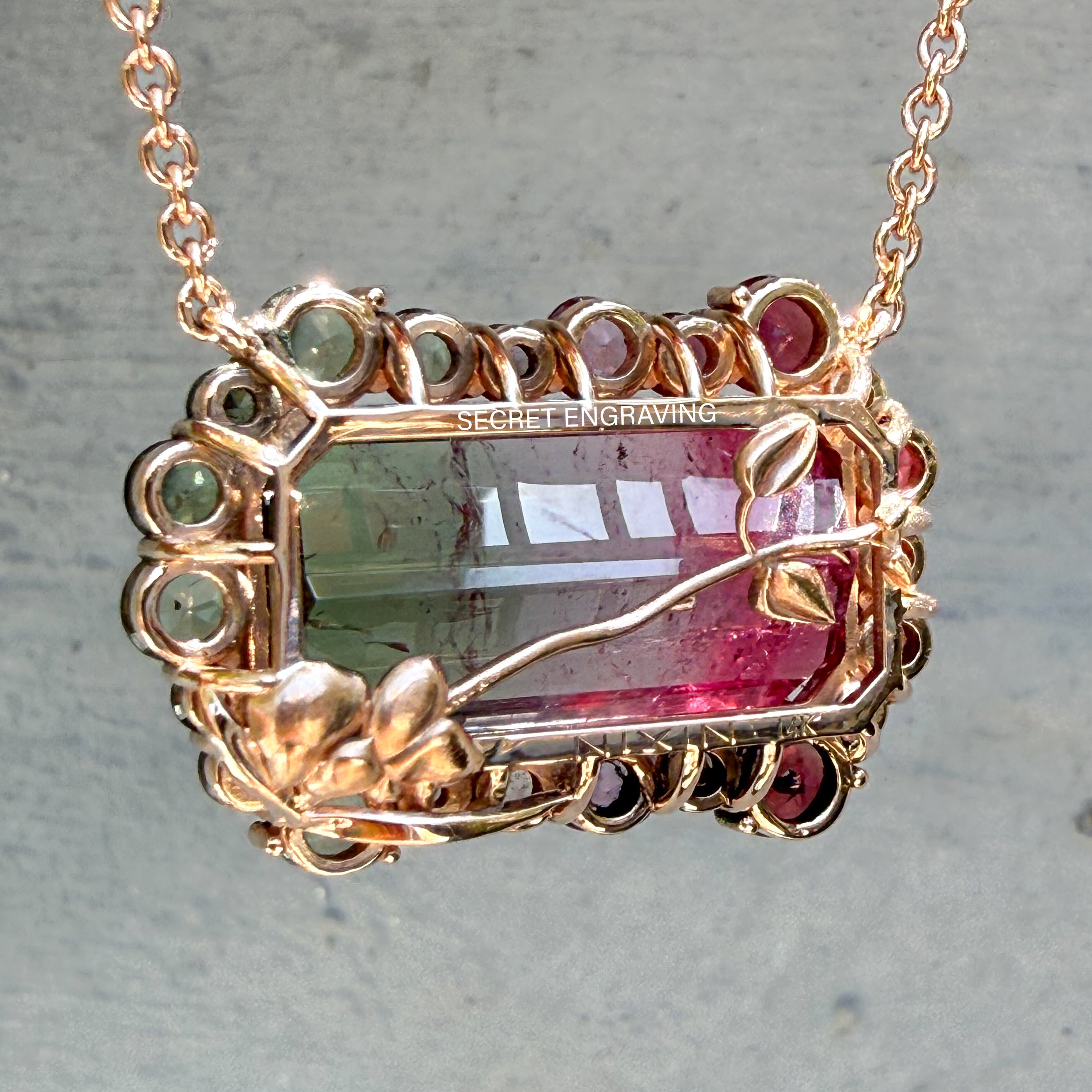
At the center of the Empress Imbued Tourmaline Necklace rests a rare tricolor tourmaline with deep pink blending into a lavender core, cooling into sage green; three moods caught in one crystal. Framed in an echoing halo of gradient sapphires, a single ruby hides among them—a quiet nod to its doppelgänger past. On the back, a sculpted ode to its namesake (recognize it?) and a private mantra await its owner—a gentle reminder that some empires are best ruled quietly.