Inspired by nature's invisible engineering
nicole gluckmanIn 1999, mathematician Thomas Hales proved that a hexagonal grid is the most efficient way to divide a flat surface into regions of equal area. While his ‘Honeycomb Conjecture’ is certainly impressive, it took him 19 pages of complex equations to confirm what bees do instinctively. But how exactly do bees construct such perfectly straight lines?

As it turns out, they don’t.
Instead, bees create circular cells by secreting a translucent, pearly-white wax from the underside of their abdomens. Mere seconds later, the warmth of the hive causes the walls of the cells to settle into hexagonal shapes due to surface tension, similar to the way soap bubbles form clusters. It’s quite literally a masterpiece of minimalist luxury, with the wax walls measuring in at roughly 0.07 mm—thinner than a strand of hair. And it’s this ultra-fragile framework that allows the bees to communicate through vibration, performing what scientists call a ‘waggle dance’ to share the location of flowers, as if the walls were telephone wires.

Macro Shot of Fresh White Honeycomb Filled with Nectar
Another remarkable process that occurs (over weeks rather than seconds) is that the wax develops rich amber tones as the bees walk over the comb with their pollen-covered feet and propolis—a sticky, resinous substance also known as bee glue. Beekeepers refer to this phenomenon as a ‘travel stain’—I like to compare it to the way gold takes on a warmer, richer glow with wear, a patina of character marked by signs of life.

Bee in a 'Travel-Stained' Hive
To make just one pound of beeswax, bees must first consume roughly 6 to 8 pounds of honey—a substance more complex than it appears. According to The Honey Association, a single colony must visit 2.6 million flowers and fly an estimated 50,000 miles to gather enough nectar to produce just one pound of it. That's more than twice around the earth. It's fitting, then, that honey and gold share the same deep, luminous color—two of the earth's most precious gifts, both arrived at through an alchemy of patience and devoted labor.

While honey earns its reverence, beeswax earns its place in jewelry history. Because the wax produced by these tiny, flying architects is malleable when warm and solid when cool, it has served as the foundation of jewelry-making for millennia—it remains largely unchanged and unimproved upon. That the same material used by ancient artisans remains essential to the craft today is not a coincidence. It is a testament to the material’s enduring purpose and the quiet perfection of what bees produce.

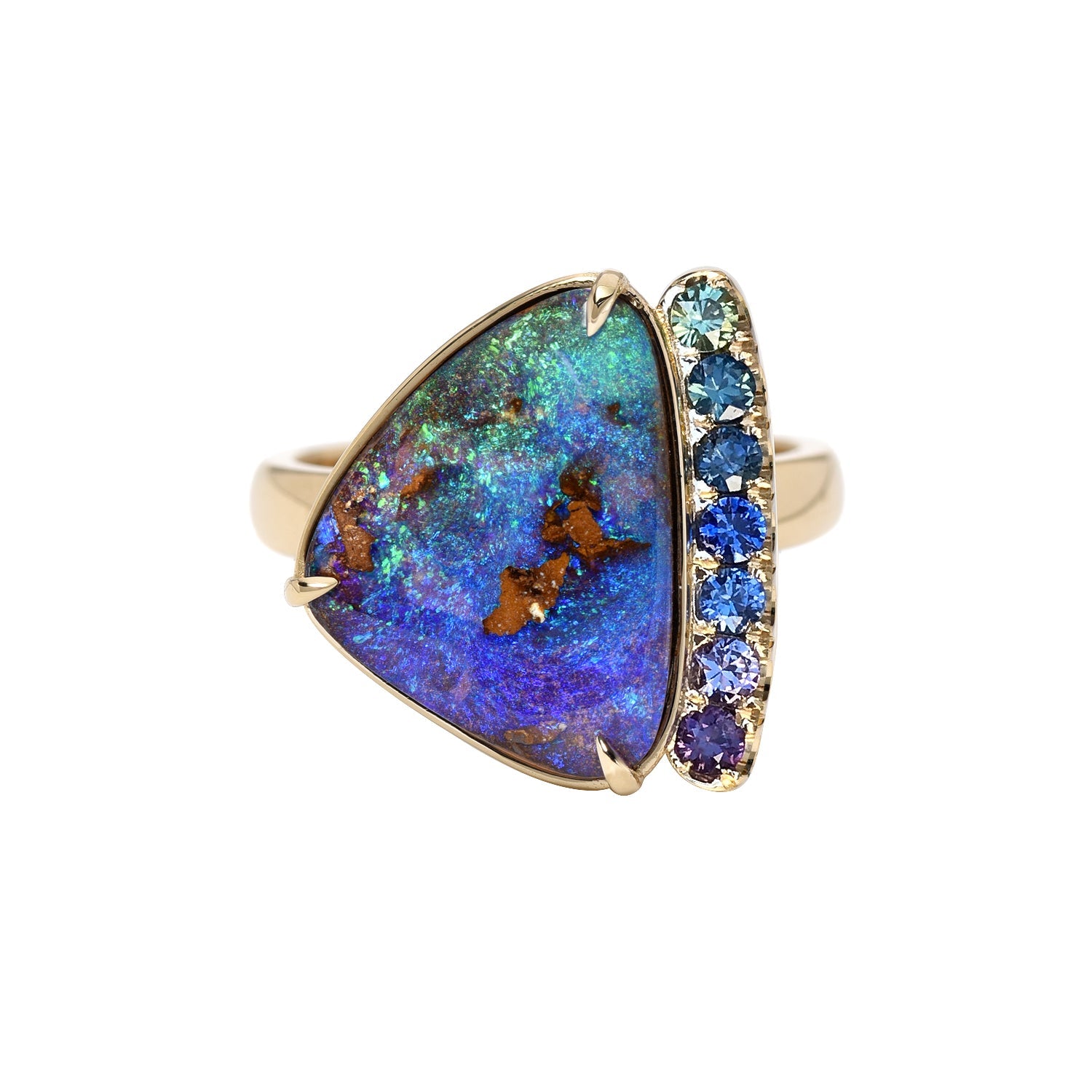
The Conjecture Necklace frames a blue and green Australian opal within an ombré halo of Montana sapphires—their gradient echoing the slow, considered geometry of the comb. In the right light, the golden honeycomb along its base emerges, a quiet tribute to the invisible architecture and the poetic nature of creativity.